API documentation, published from Git
Turn the OpenAPI, AsyncAPI, GraphQL and Markdown files in a repository into one documentation site. Publish a version from any commit, give it a theme and your brand, and choose who can read it.
Public documents and Try It Out are on every plan, including Free.
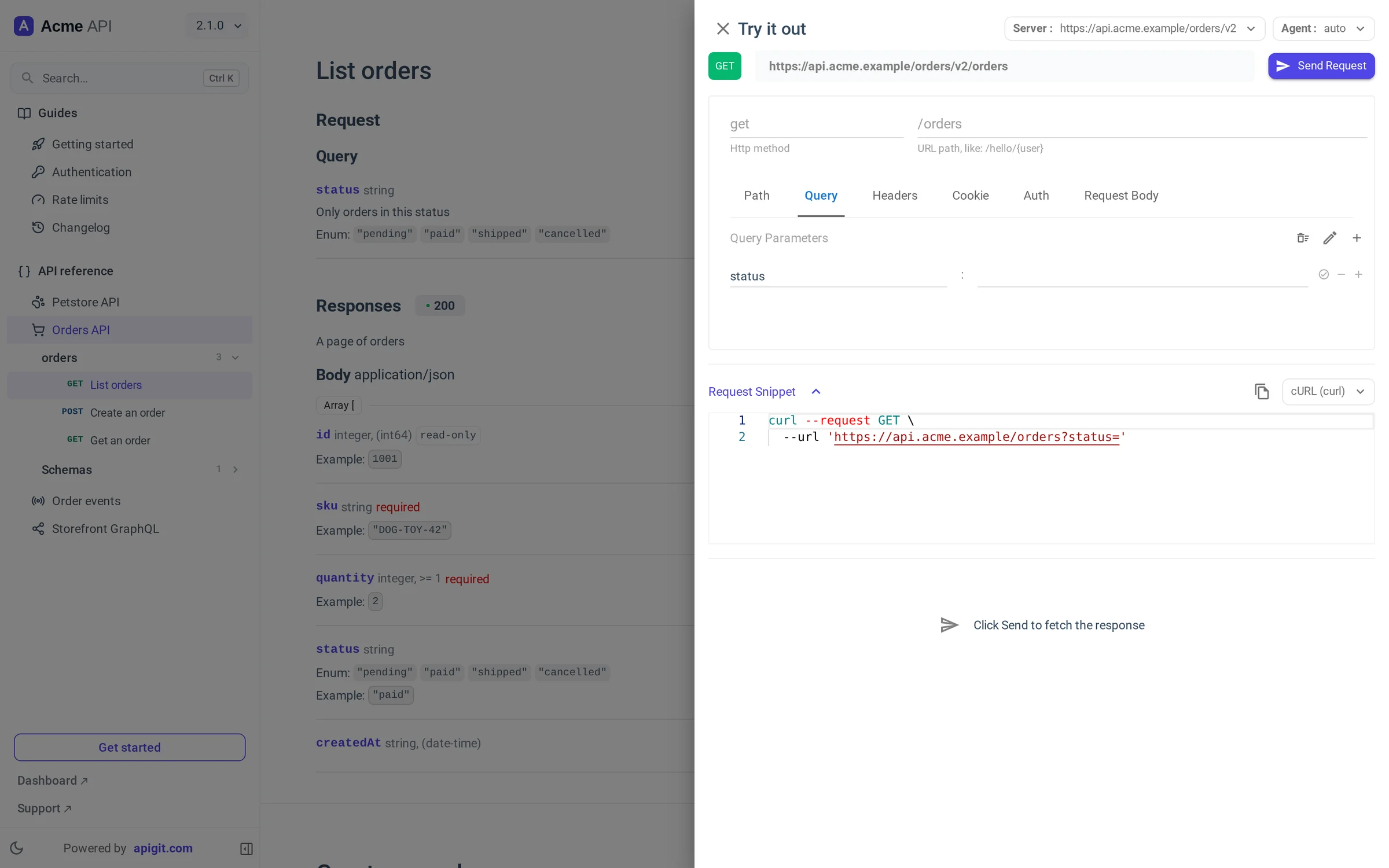
A version is a name pointing at a commit
Publishing builds nothing. Readers see the repository at that commit, so a publish is instant and shows exactly what was committed and reviewed.
Publish from any branch or commit
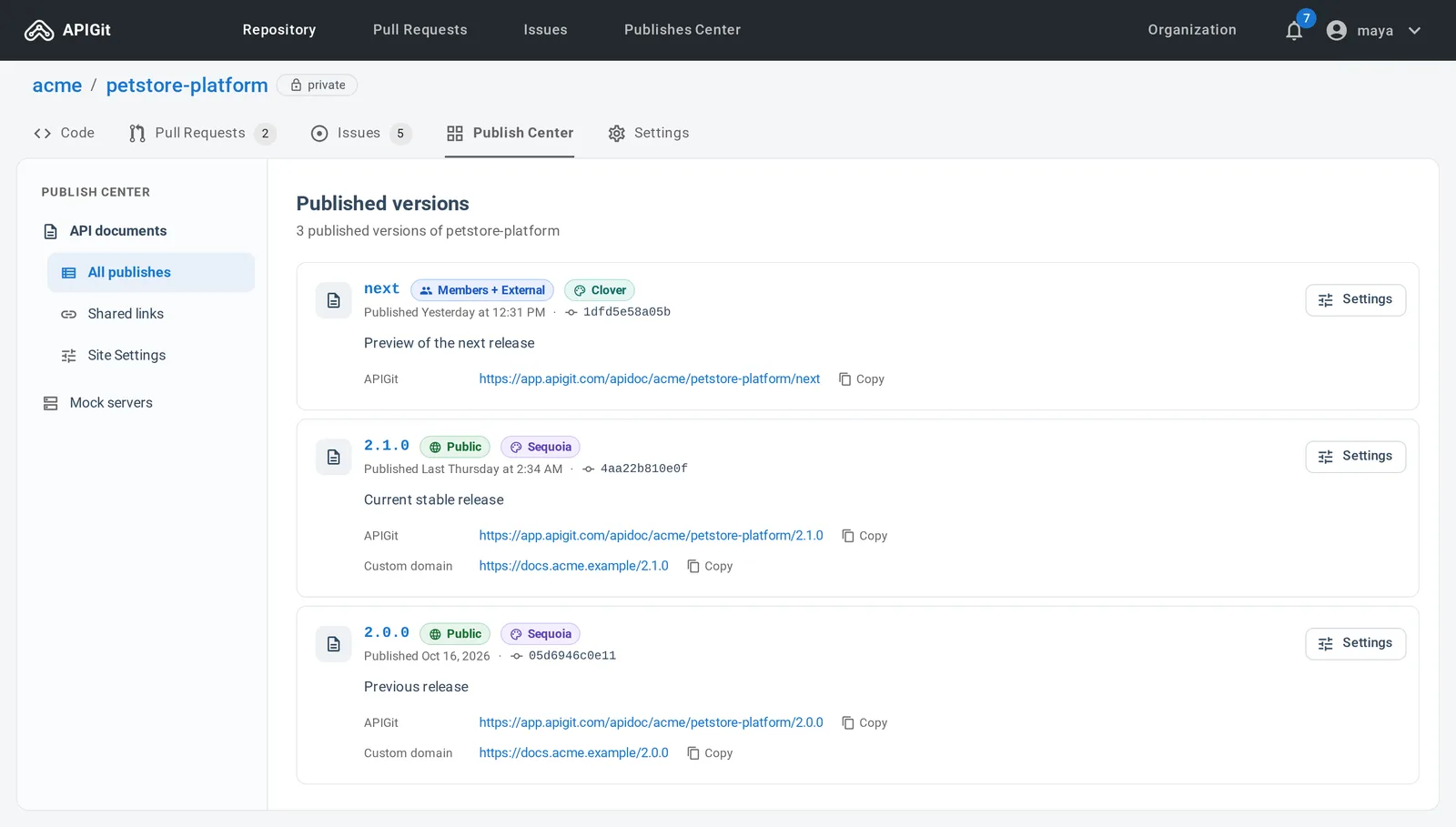
Give the version a name such as 2.1 or next and it gets its own address. Versions can run side by side, even from one commit: a stable release for partners and a preview for your own team.
- Publish from a branch, from the commit list, or without leaving the editor
- As many versions as your plan allows, each with its own URL and access
- Overwrite a version and keep its URL, access, external viewers and shared links
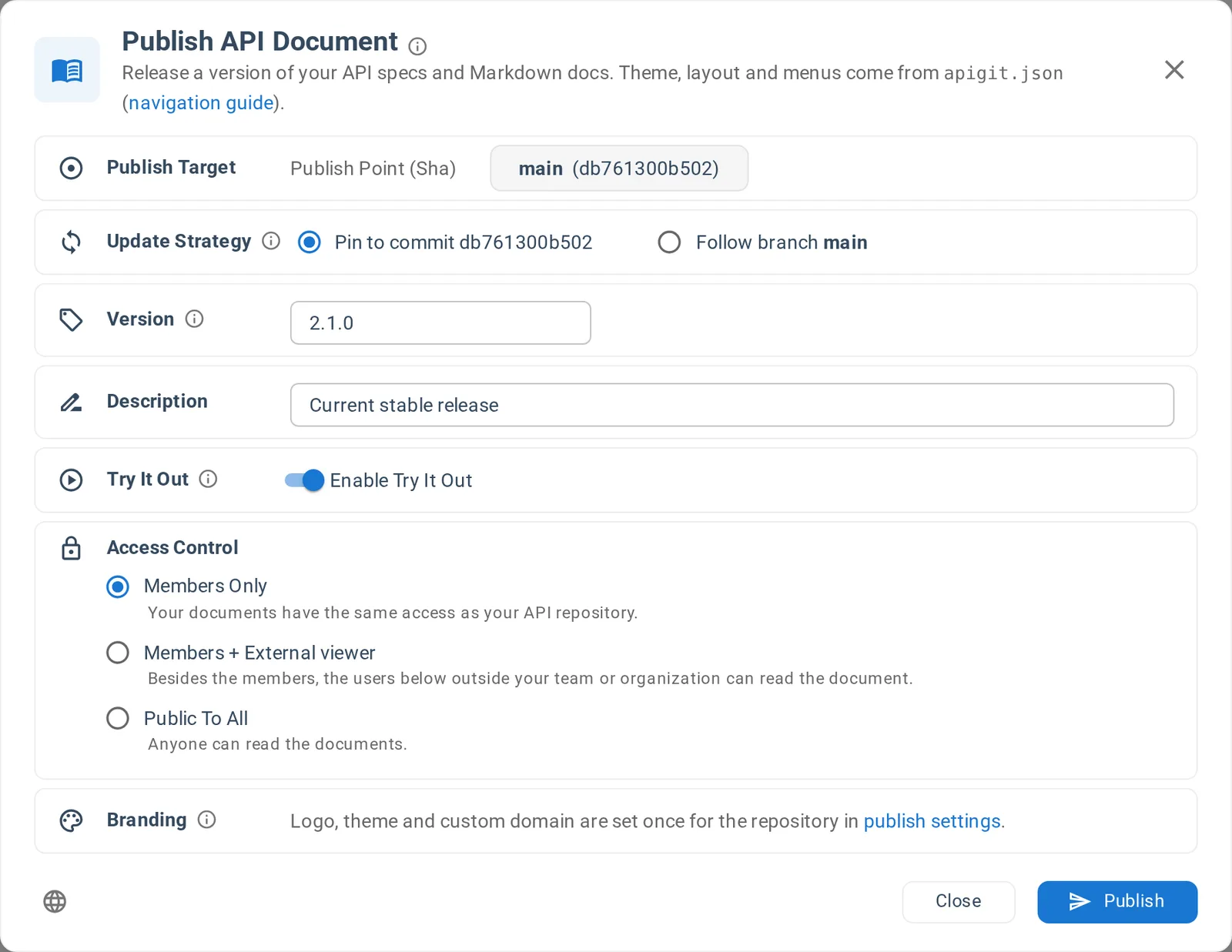
Pin a release, or follow a branch
A pinned version stays on its commit until you publish again, which is what a release needs. On Team and Enterprise a version can follow a branch instead: a push, a merged pull request or an edit reaches readers within seconds, with nothing to rebuild.
- Switch between pinned and following at any time
- The URL, access control and shared links stay the same across updates
- Each version shows whether it is pinned or following, and which branch
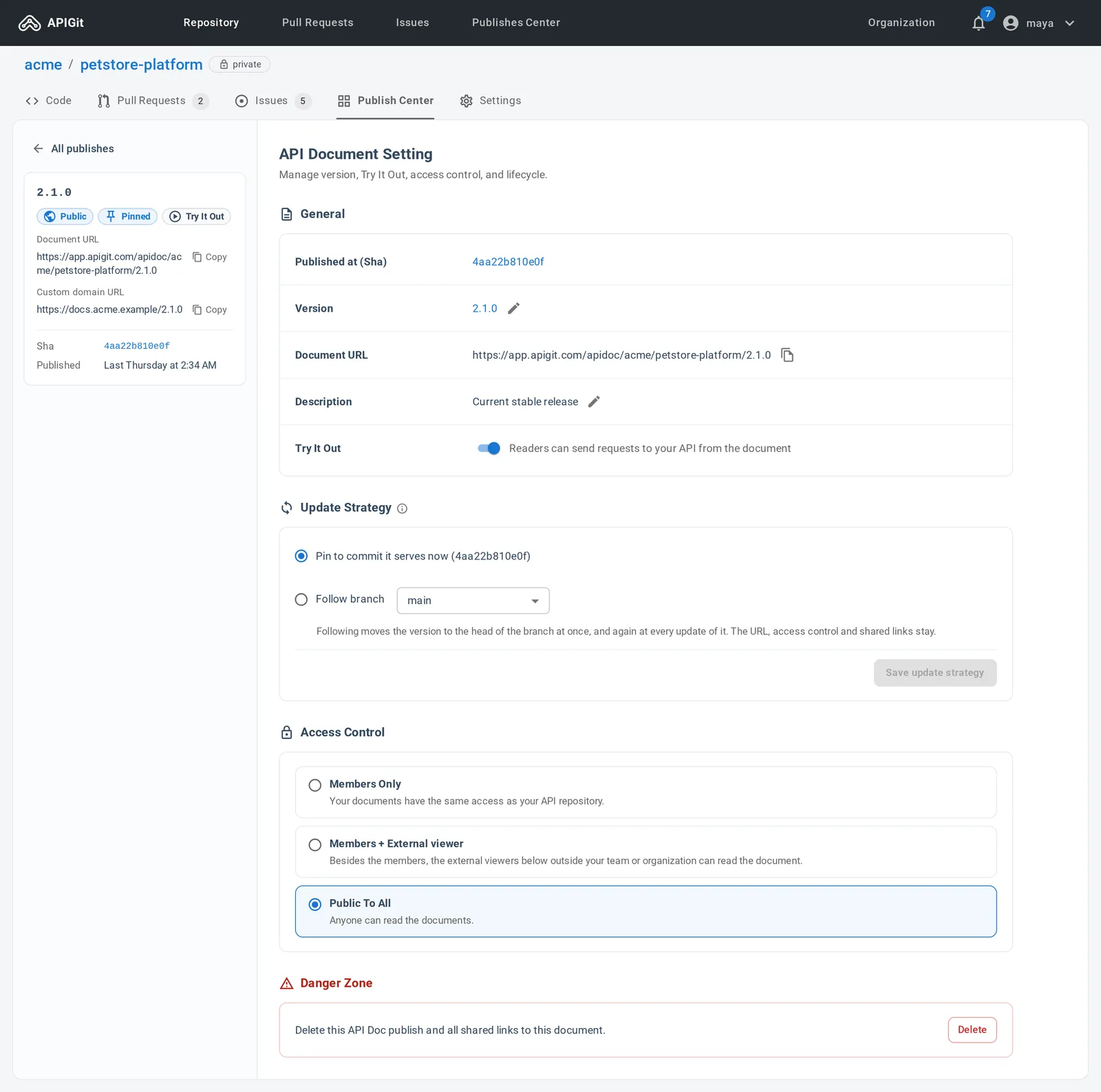
The right docs for each audience
Access belongs to each version, so one repository can serve your team, your partners and the public at once. External viewers do not use a paid seat, and a shared link needs no account.
- Members only, members plus named external viewers, or public to all
- Shared links, with an optional password
- Try It Out for readers, switched on per version
Seven themes, and one screen for everything else
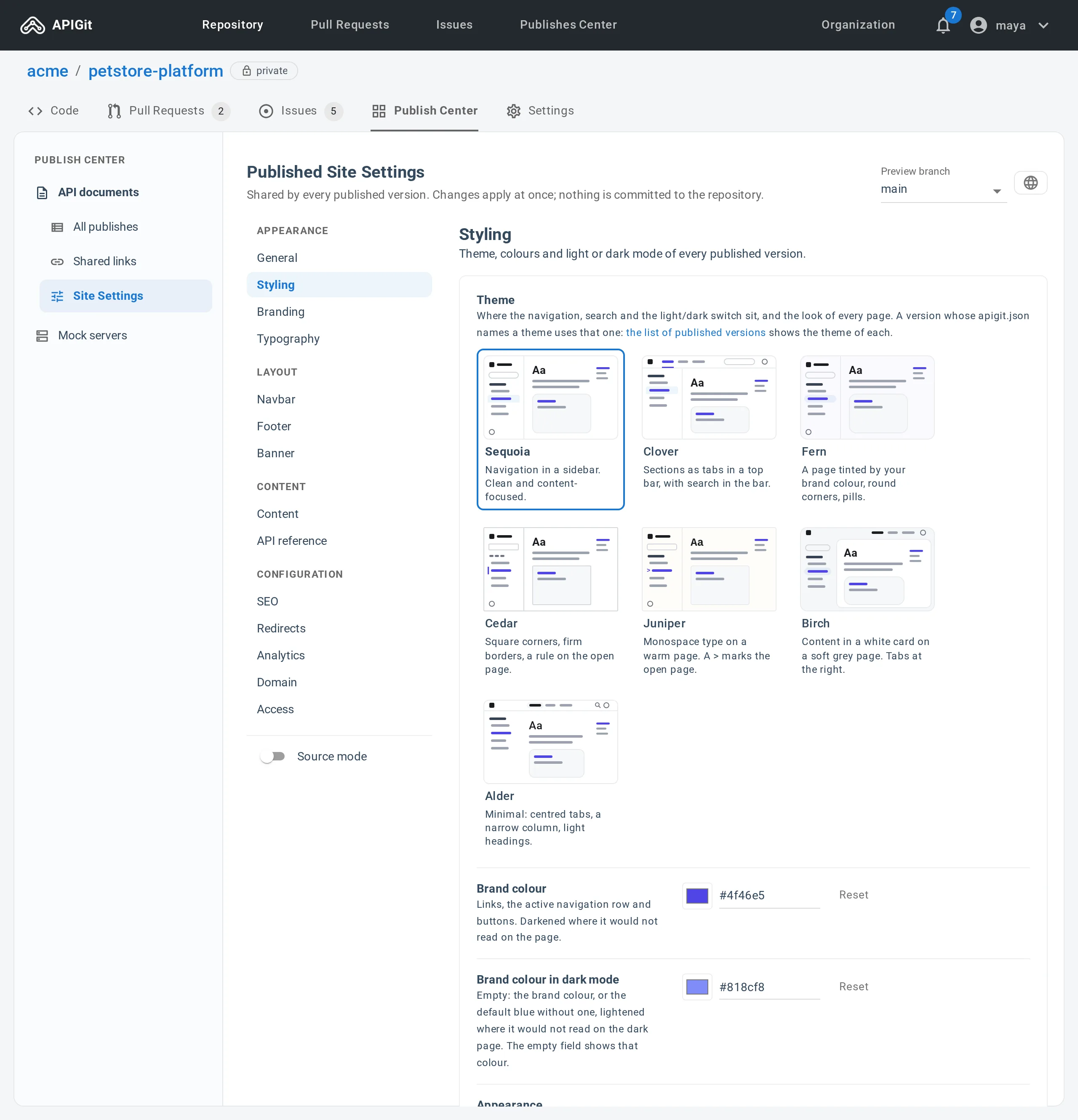
A theme decides where the navigation, search and the light/dark switch sit, and the corners, borders, background and type of every page. Pick one, then put your brand on top. Your content and navigation stay as they are, and you can switch at any time.
Navigation, search and the light/dark switch in a sidebar. The default.
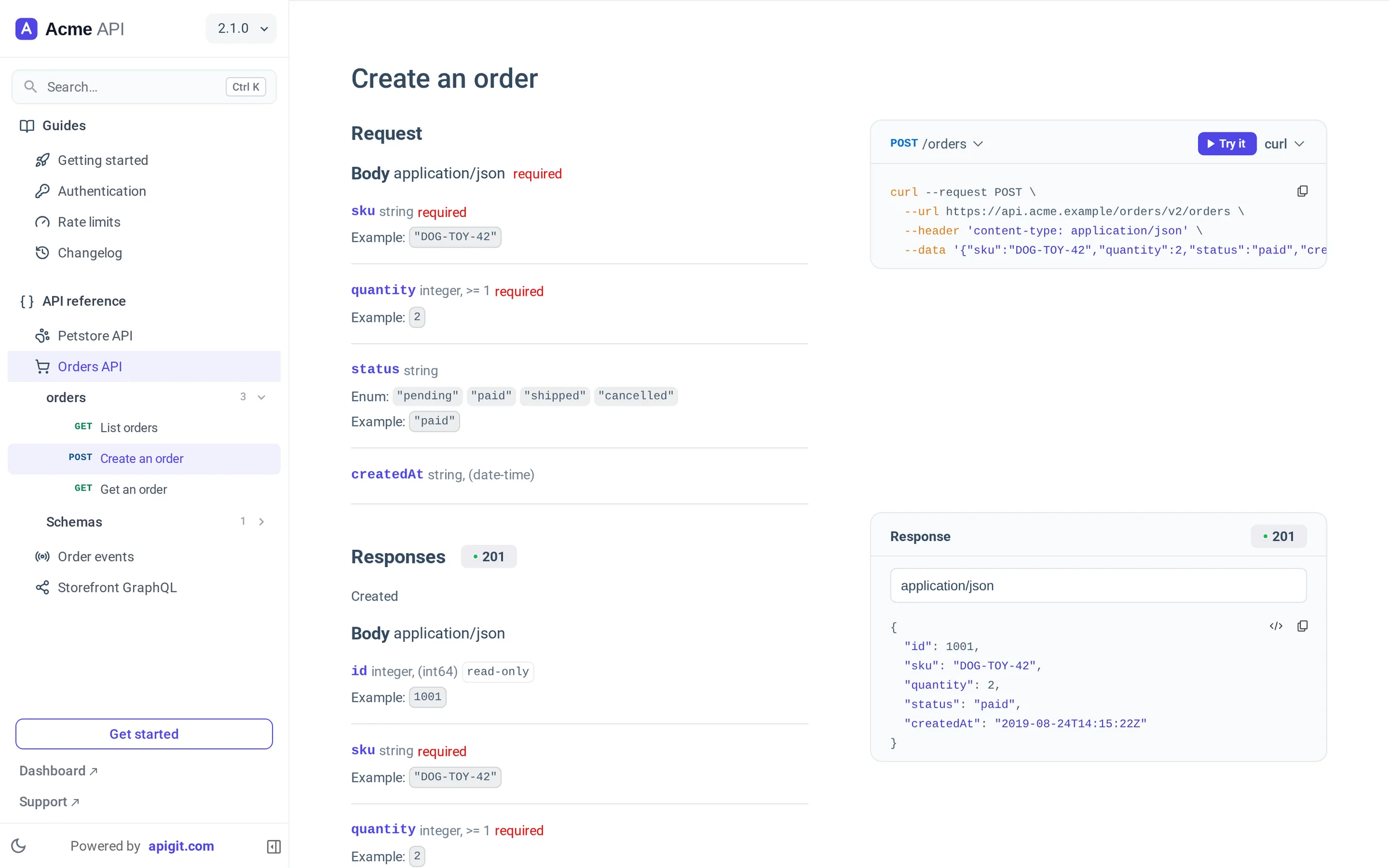
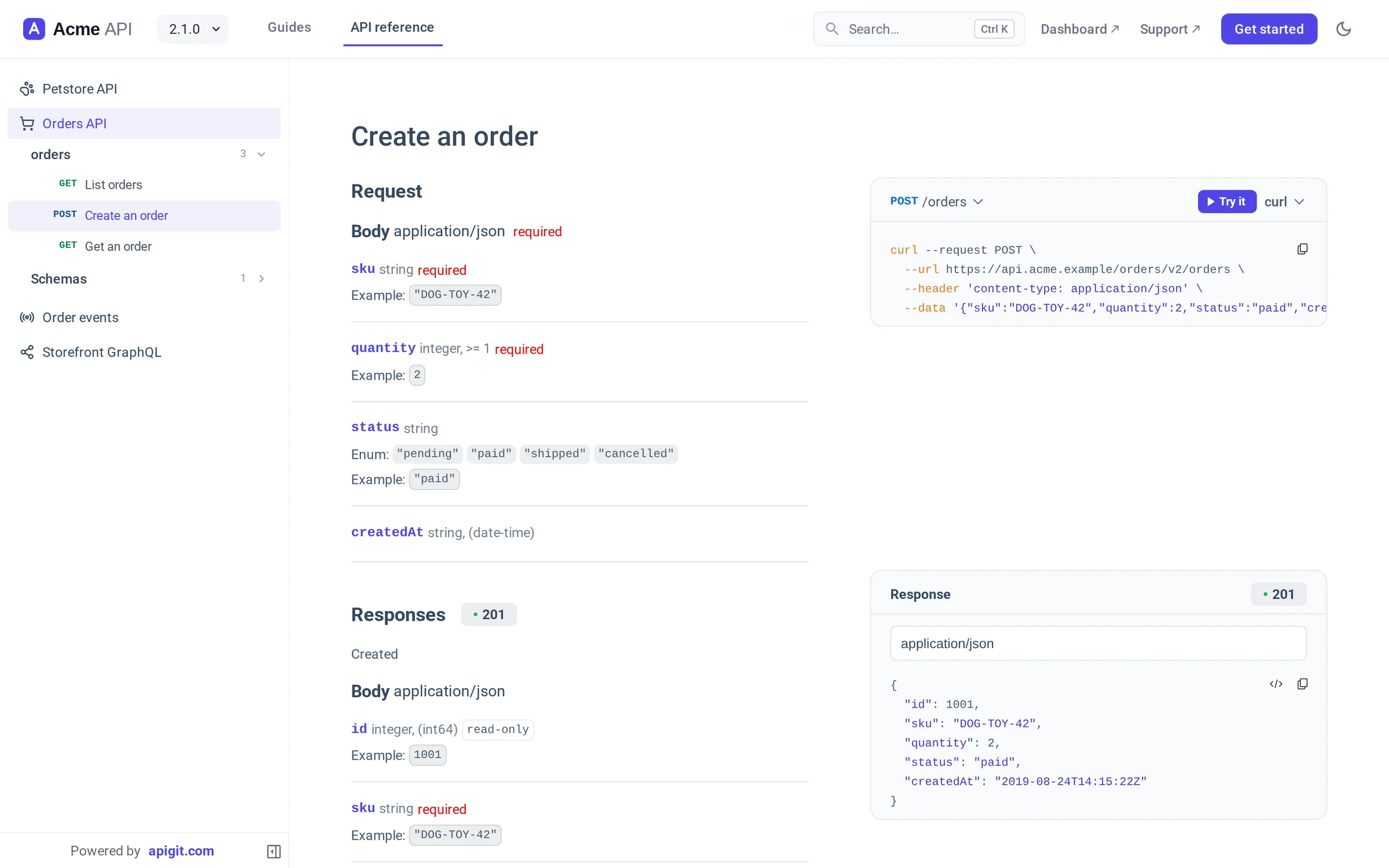
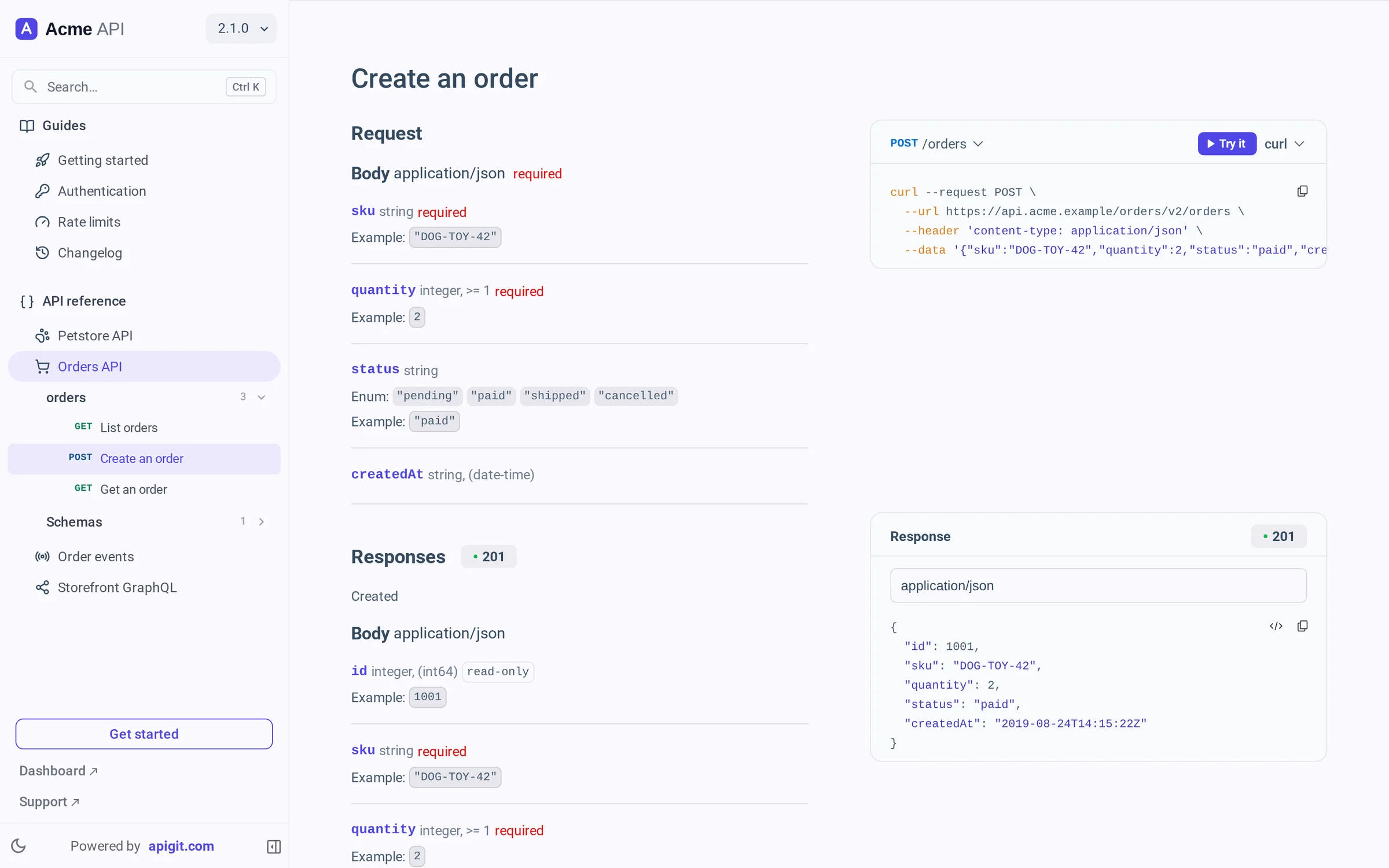
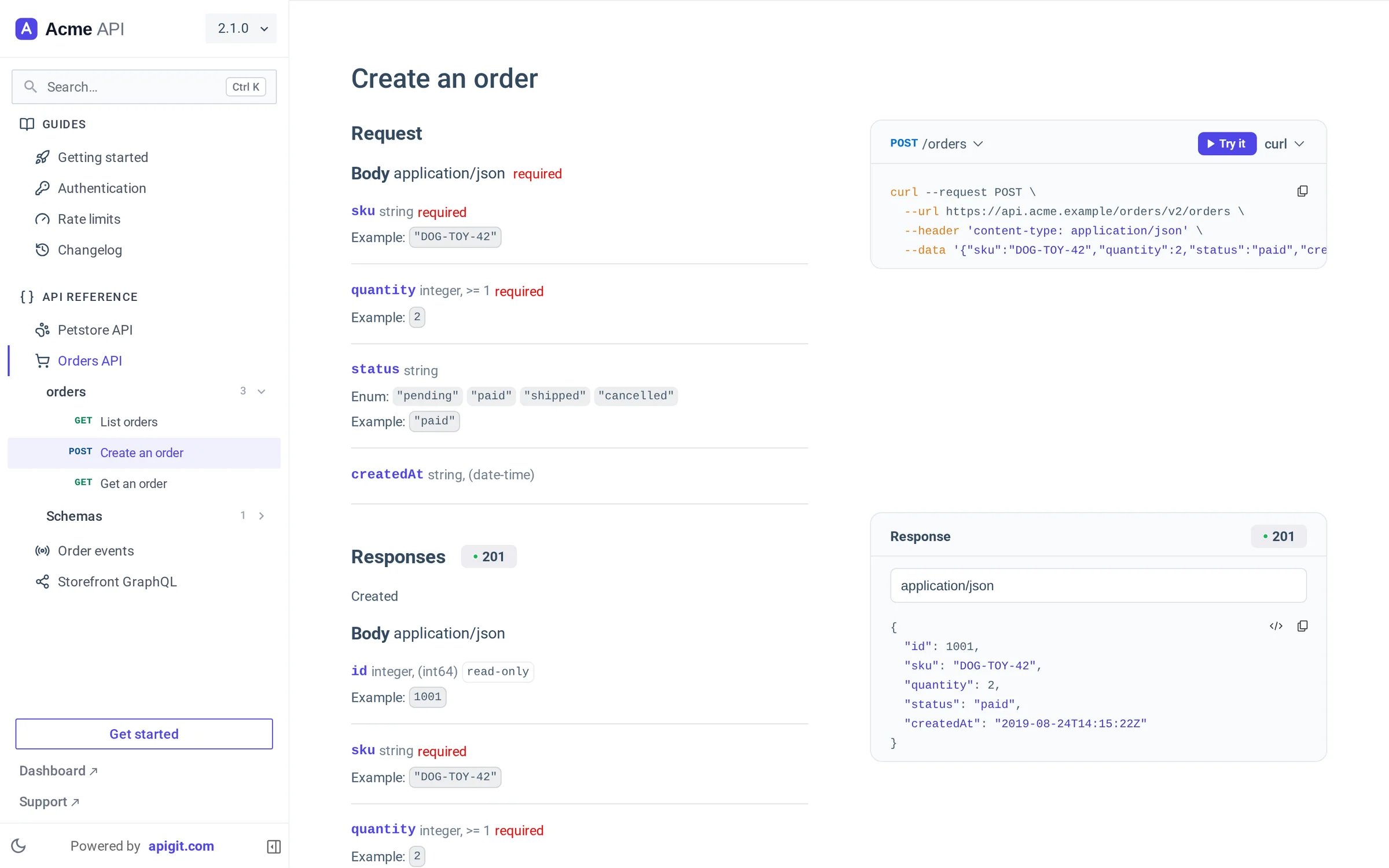
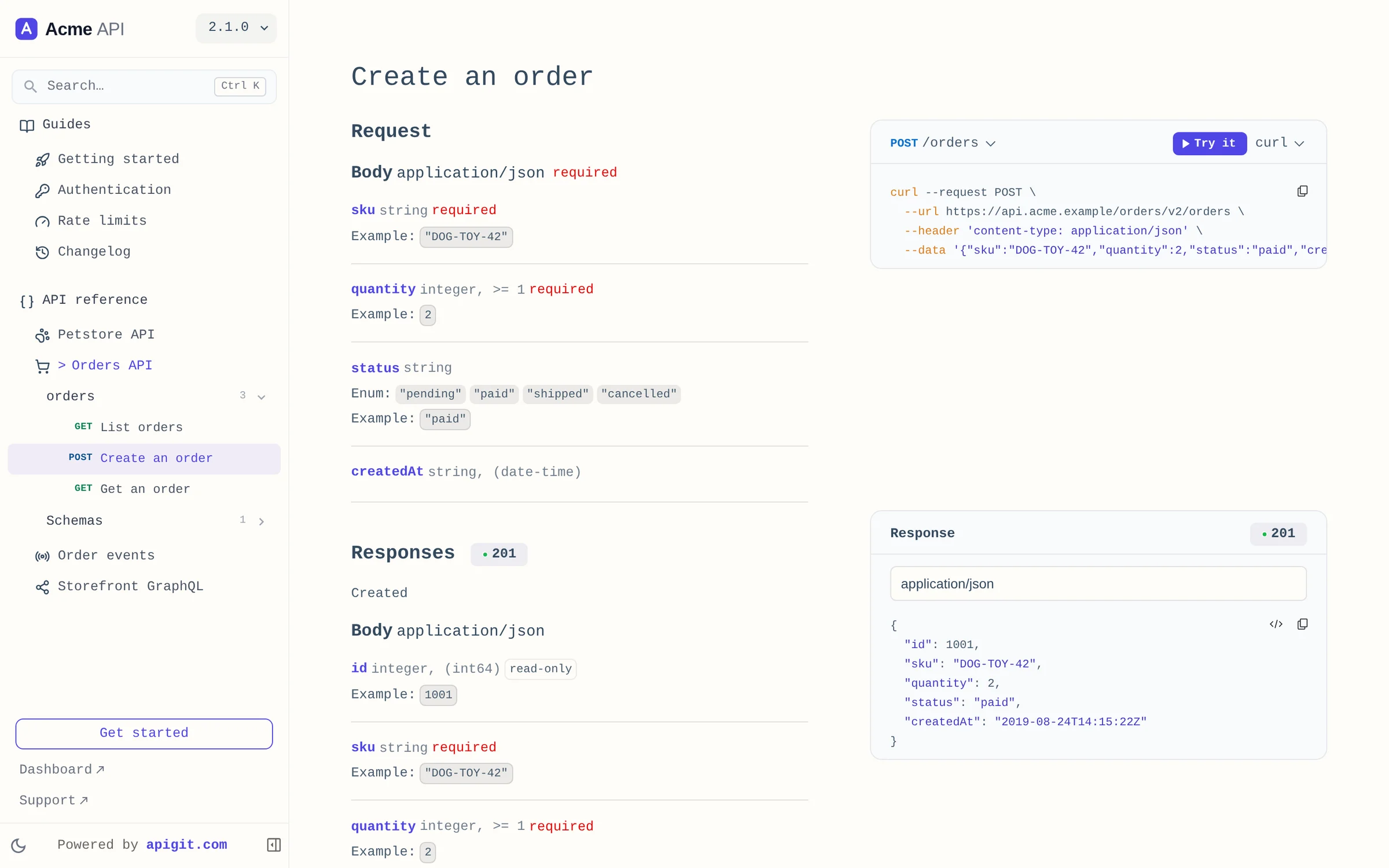
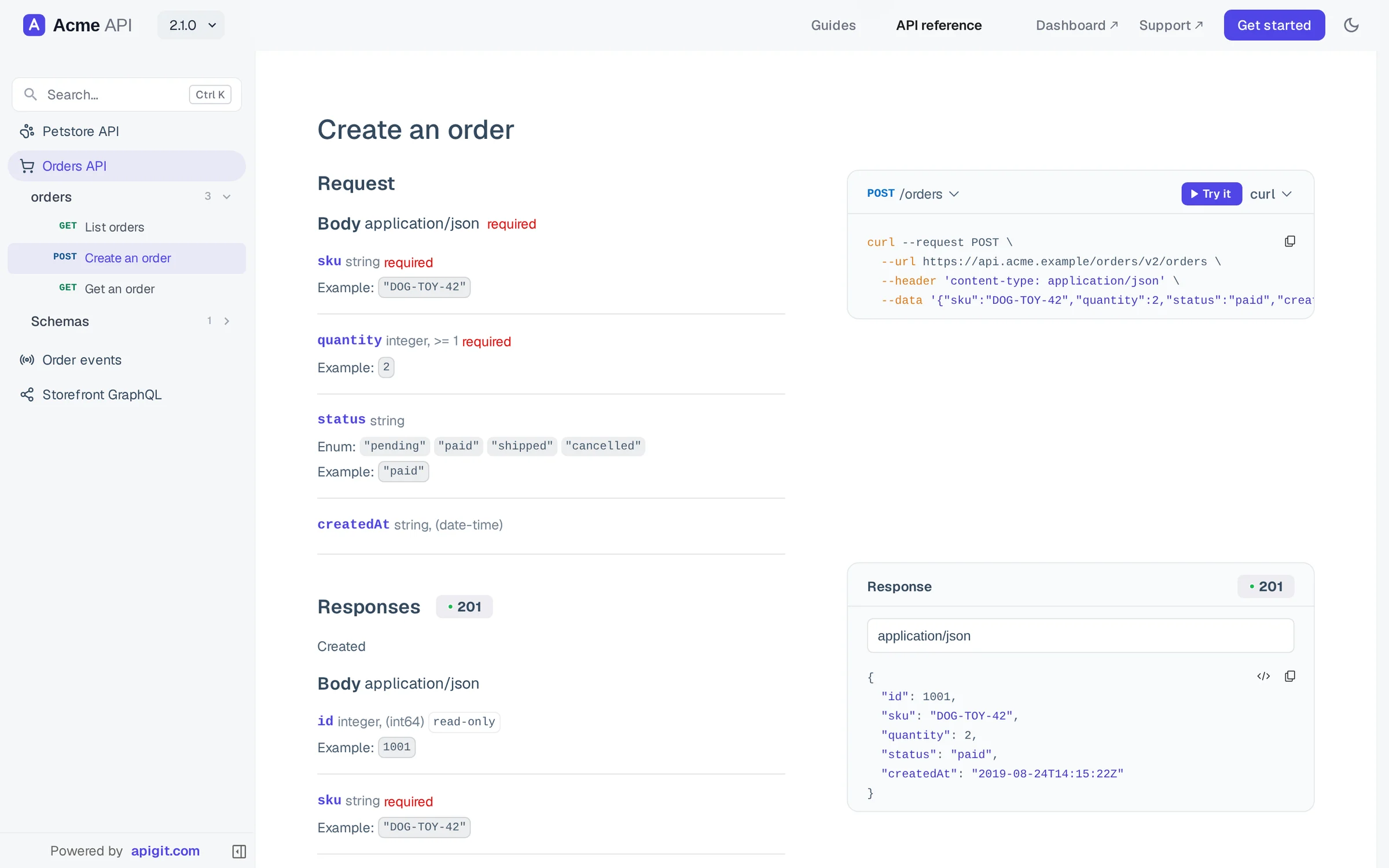
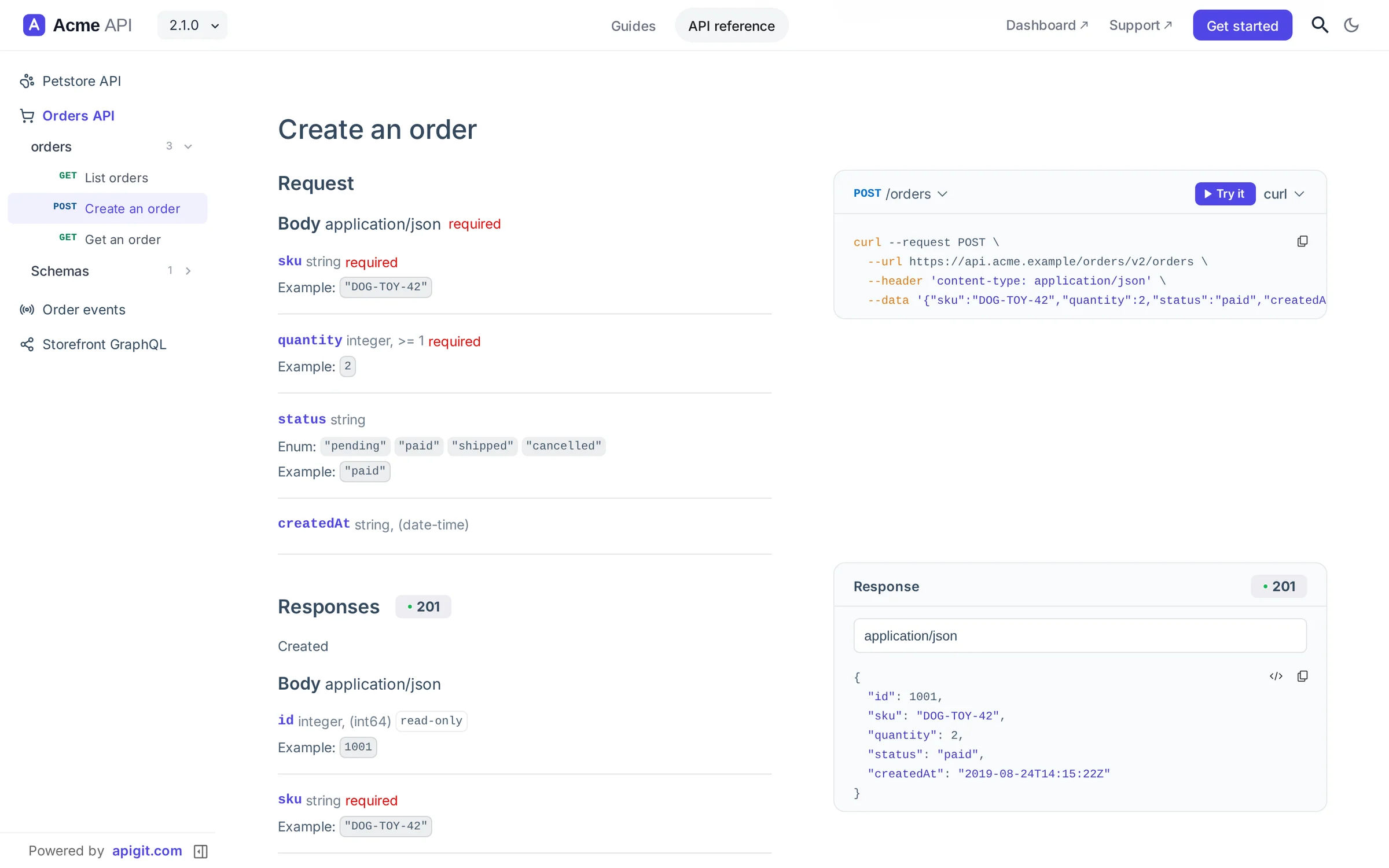
All seven have a light and a dark version, and work on a phone, where the navigation moves into a drawer.
Site settings in one screen
Every repository has one settings screen for its published documents. A saved change applies at once to every published version, including those pinned to an older commit. Nothing is committed and nothing is published again.
- Appearance
- Theme, brand colour with a second one for dark mode, light, dark or the reader's system setting, heading and body fonts, a wide logo with a dark-mode version, and a favicon.
- Layout
- A button and up to six links in the header, a footer with text, links and social accounts, and a one-line announcement banner readers can dismiss.
- Content
- The Copy page menu, a last-updated date under Markdown pages, a three-panel or stacked API reference, and where the list of operations is shown.
- Configuration
- Search engine listing, social image, verification tags, redirects, your Google Analytics ID, a custom domain, and whether AI agents may read the site.
A colour that stays readable
Brand colour is used for links, buttons and the open item in the navigation. A colour that would be hard to read on the page is darkened until it has enough contrast, and the screen tells you which colour is shown.
A different theme for one version
Set theme in the apigit.json of a commit and the versions published from it use that theme. The list of versions shows which theme each one uses and where it is set.
Look before your readers do
The Preview button shows a branch with the saved settings. Source mode shows most panels as one JSON object, to copy the settings of one repository to another.
Your navigation, and search that covers the API
Without configuration a published document lists every spec and Markdown file at its commit. Add an apigit.json to choose what is shown and in which order.
Edit the navigation in a form
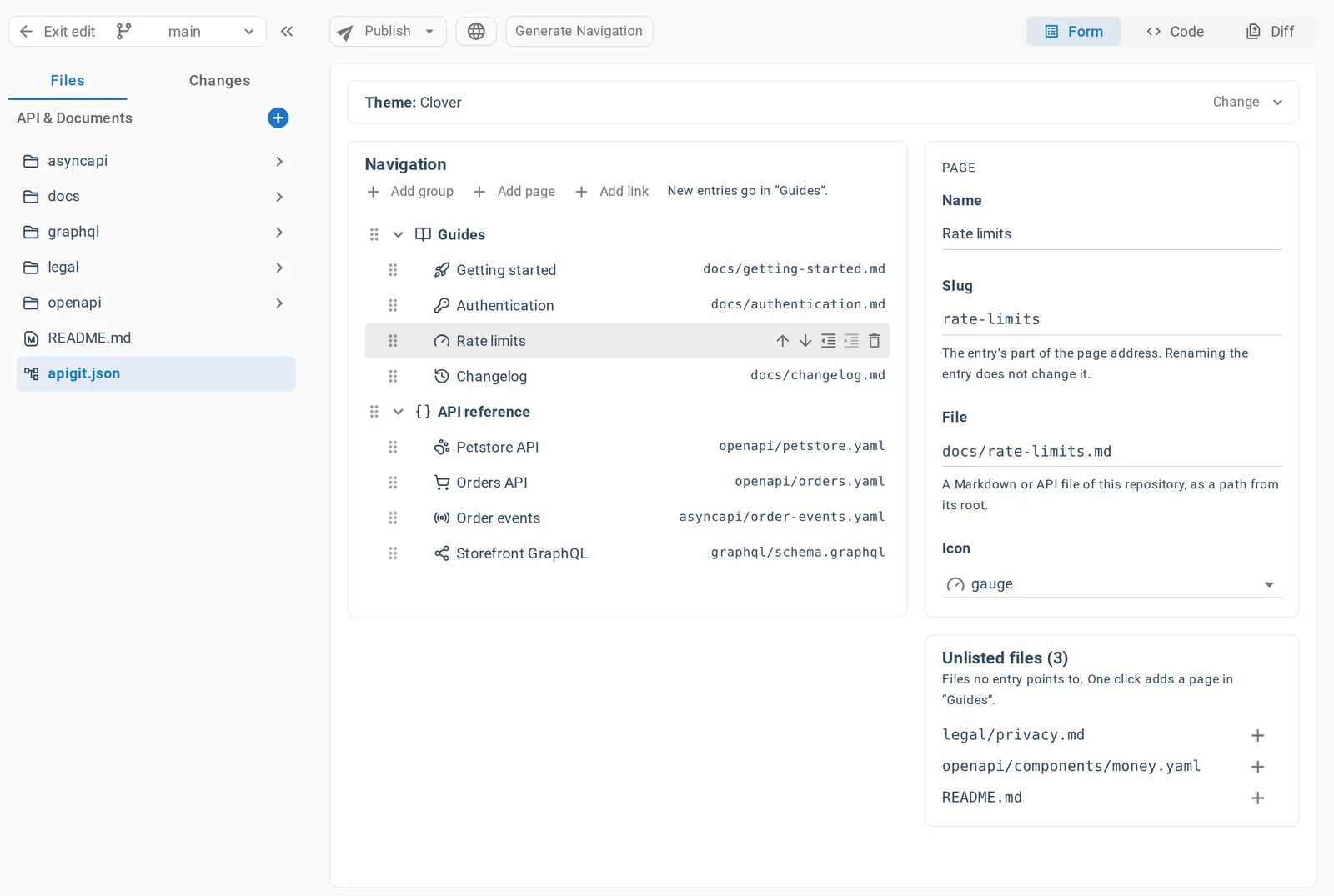
Open apigit.json and click Edit: add groups, pages and links, drag them into place, and pick an icon for each. The form lists the files no entry points to, and warns on an entry whose file no longer exists. Renaming an entry keeps its slug, so the addresses of published pages do not change.
- Groups, pages, external links and icons
- Form, Code and Diff edit the same file; a form edit changes only the lines it touches
- In Clover, Birch and Alder the top-level entries become the tabs of the top bar
Ctrl K finds pages, operations and schemas
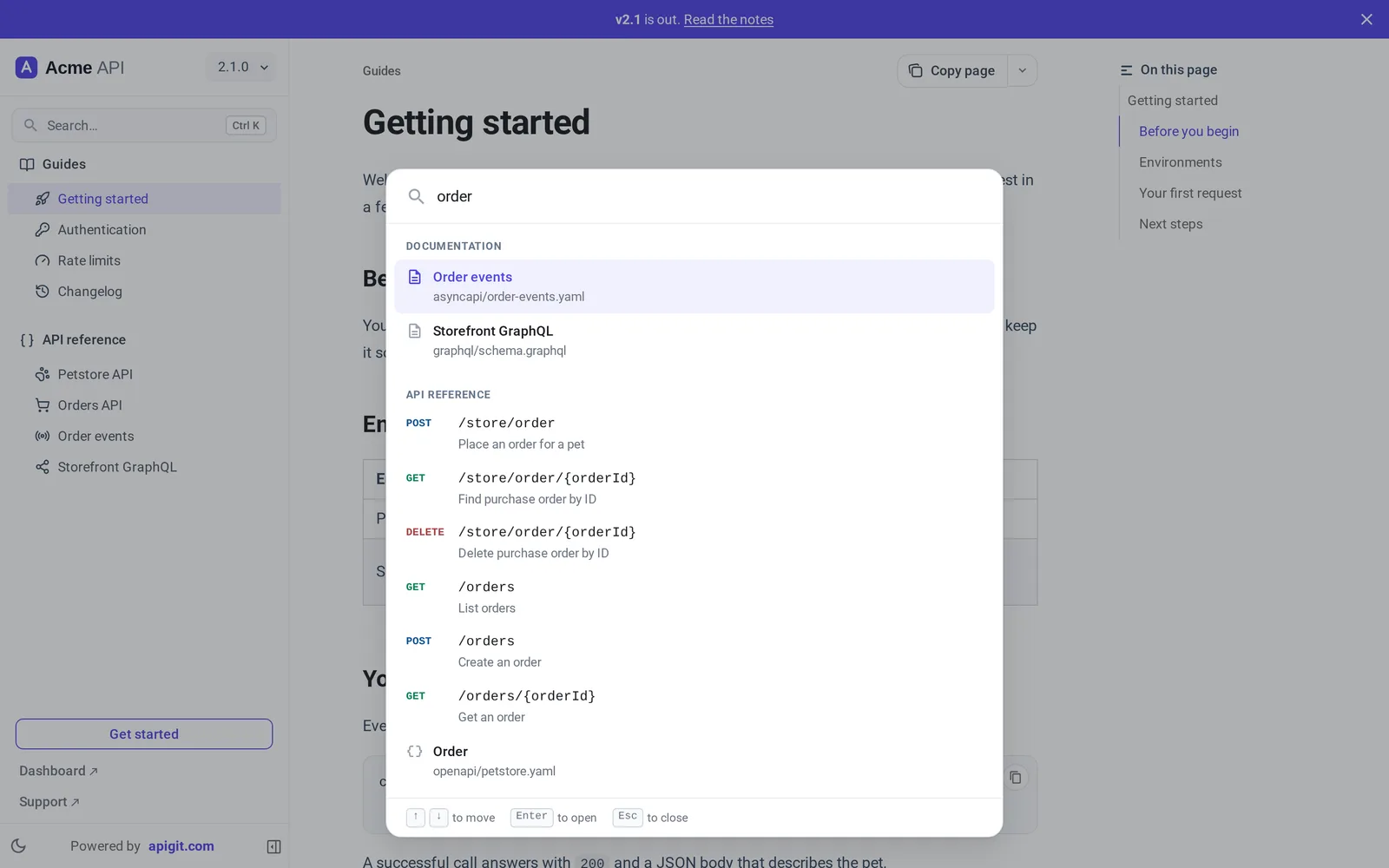
Every published document has a search box. Results come from the version being read: Markdown pages by title, path and headings, and the operations and schemas of its OpenAPI documents. The operations of an API are also listed in the site sidebar, under the document's entry, beside your guides.
- Ctrl K, ⌘ K on a Mac, or /
- Choosing an operation opens the reference at that operation
- Search follows the access of the version: readers find only what they may open
References and guides in the same site
One published version can hold REST APIs, event APIs, GraphQL schemas and the Markdown pages that explain them.
OpenAPI, AsyncAPI and GraphQL references
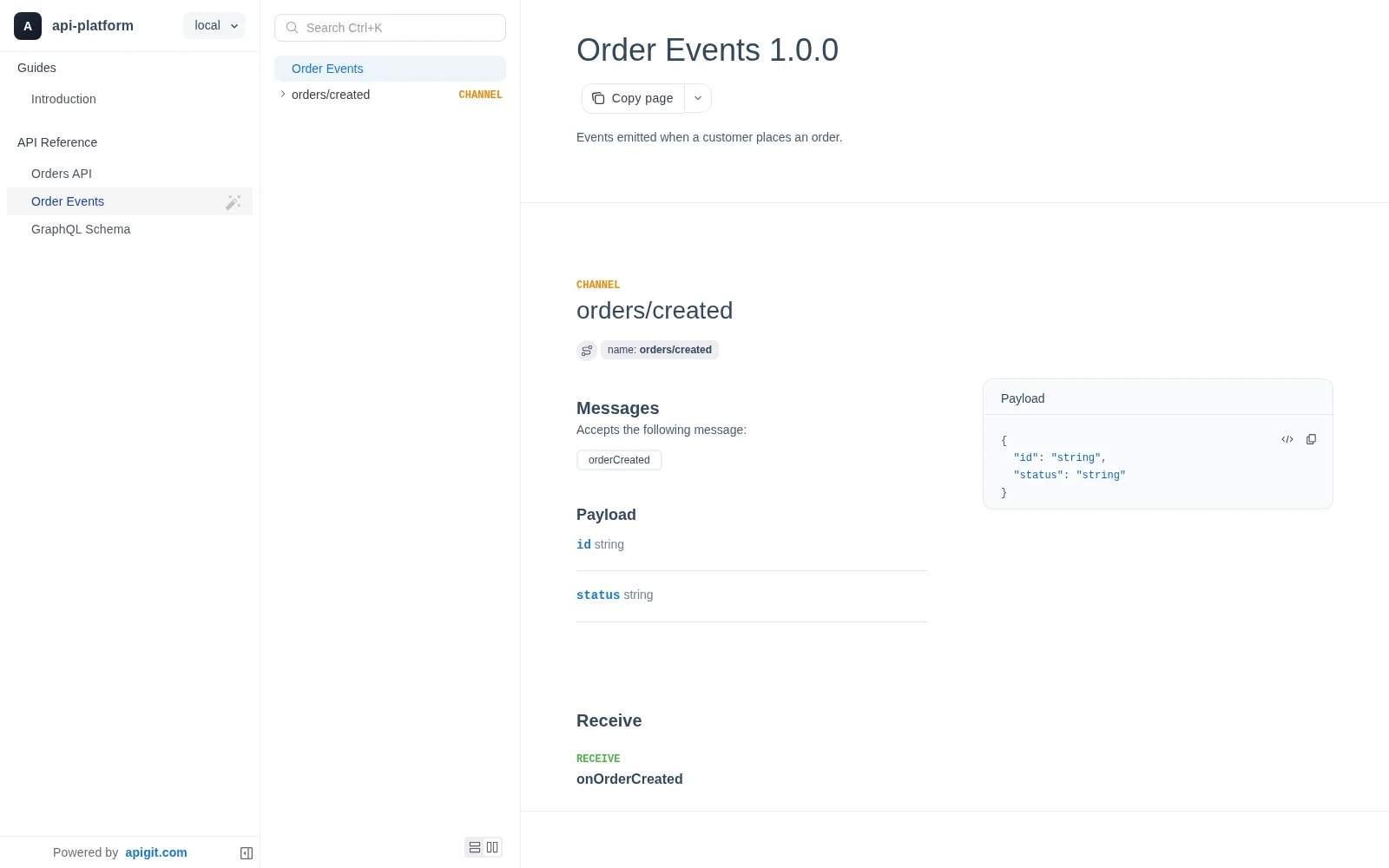
OpenAPI 3.0 and 3.1, Swagger 2.0, AsyncAPI 2.x and 3.x, and GraphQL SDL are rendered by one Redoc 3 viewer. Readers can copy a document or download its original file. OpenAPI also has Try It Out, request snippets in the language the reader picks, and model code generation.
- Three-panel or stacked reference layout
- Try It Out for OpenAPI operations, on every plan
- Bundled or original downloads for OpenAPI and AsyncAPI, in JSON or YAML
Markdown with components
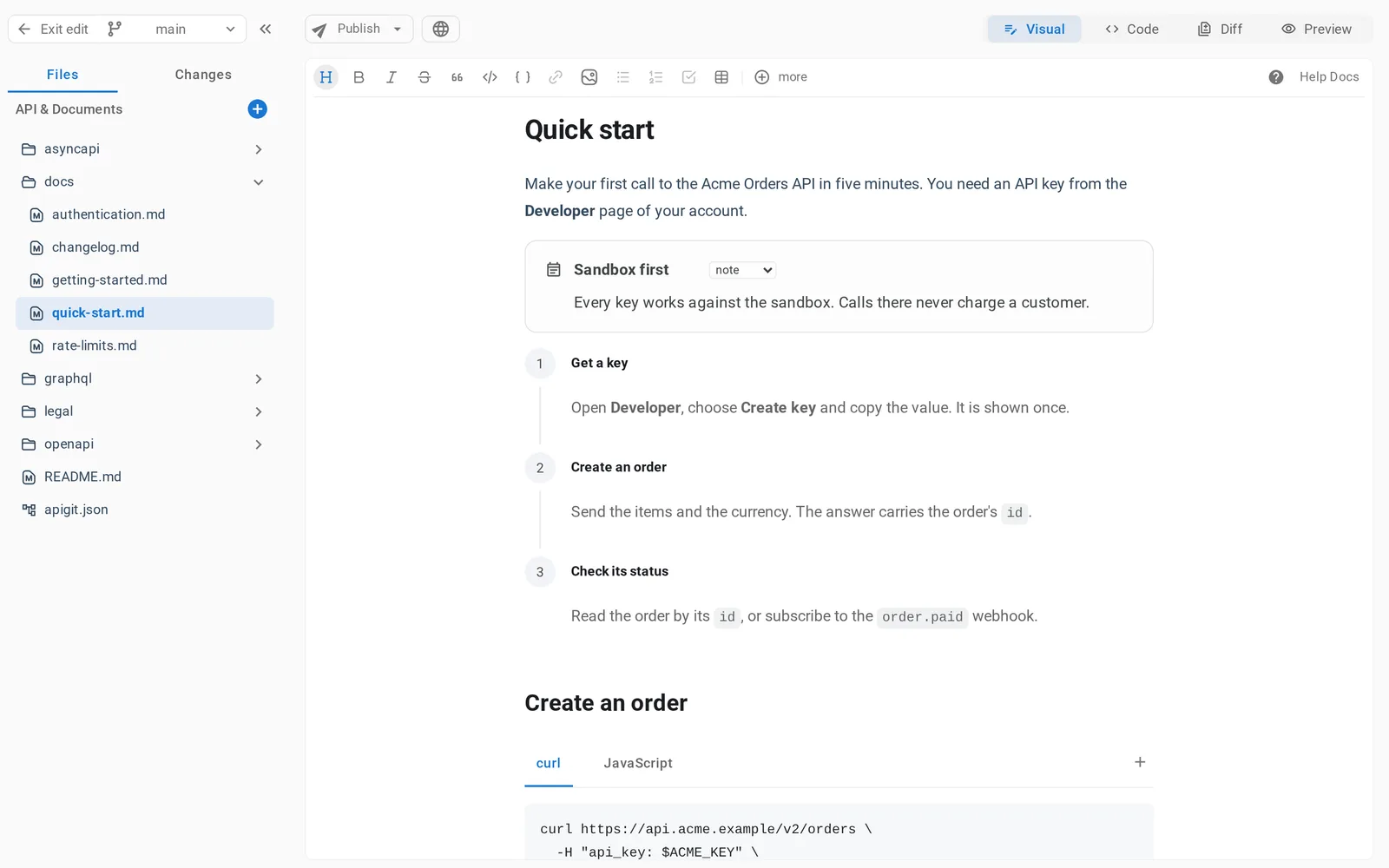
Write guides as .md or .mdx files in a visual editor, where you type into the page as readers will see it, or as code with a preview that updates while you type. Beyond standard Markdown there are tabs, callouts, cards, steps, code groups, accordions, Mermaid diagrams, formulas, videos and embeds. Code blocks take a title, line numbers, highlighted lines and added or removed line marks.
- Frontmatter sets a page's title and description, or keeps it out of search engines
- Tabs with the same labels follow the reader's choice across a page
- Paste a screenshot or use the toolbar: images upload to the repository
On your own domain, ready for search engines
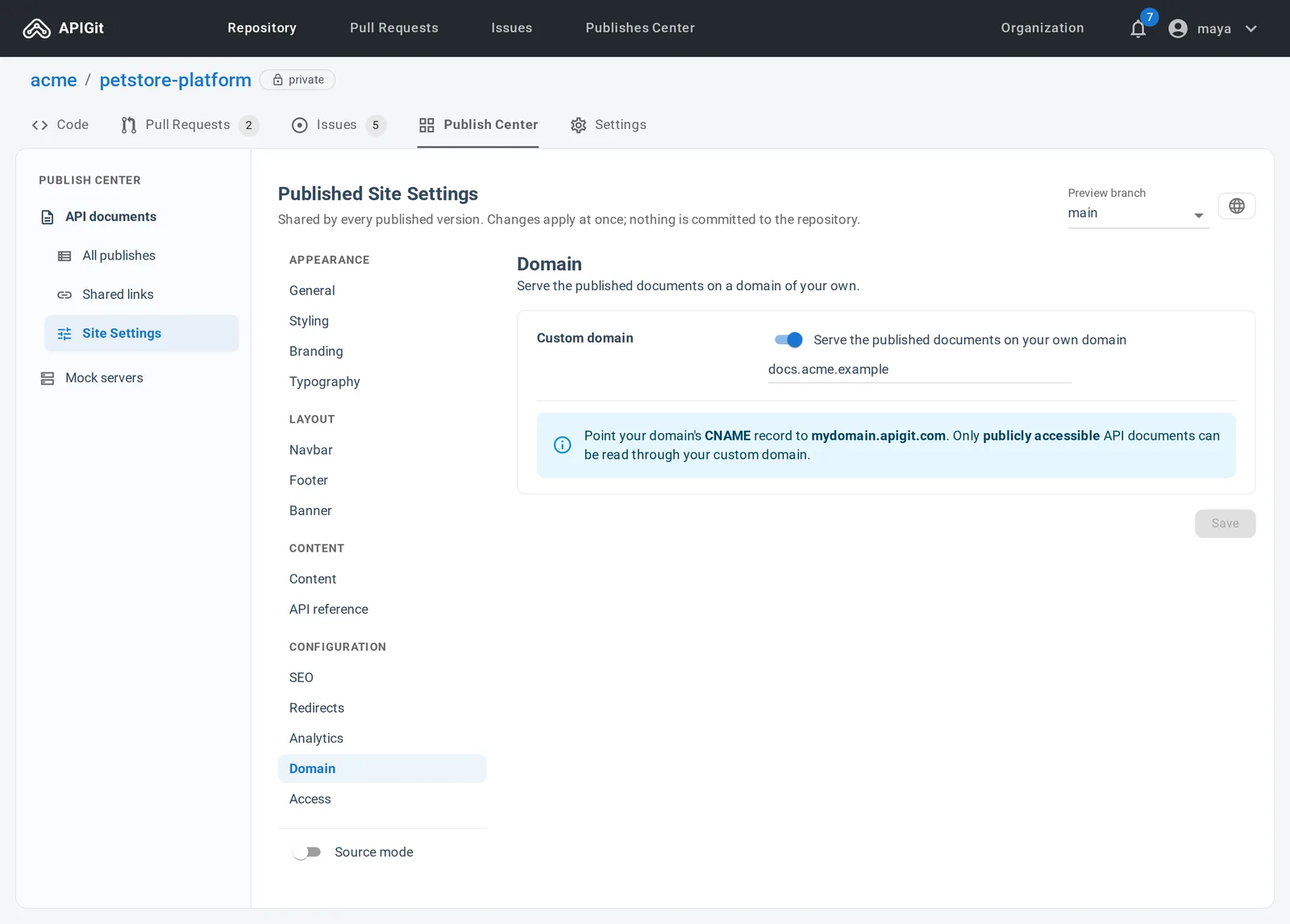
On Team and Enterprise, point a CNAME record at APIGit and your public documents are read on your own domain.
A custom domain is a setting and a DNS record
Switch the domain on in the site settings and add the record at your DNS provider. Each page is then sent with its own title, description, canonical address and text, so crawlers and link previews read it without running JavaScript.
- Your logo, favicon, colours, header links, footer and banner on every plan
- The APIGit badge can be removed on Enterprise
Sitemap and robots.txt
The sitemap lists the pages of the newest public version. Older versions point to it as the canonical address, so versions do not compete in search results.
Social image and verification
Upload the image shown when a page is shared, and add the verification tags search engines and social networks ask for.
Redirects for moved pages
When you rename a page or remove a version, a rule sends the old address to the new one. A rule applies only where no page exists, so it never hides a live page.
Your own analytics
Enter a Google Analytics 4 measurement ID to count your readers. It measures your published document and nothing else.
Readable by AI agents, with the same access rules
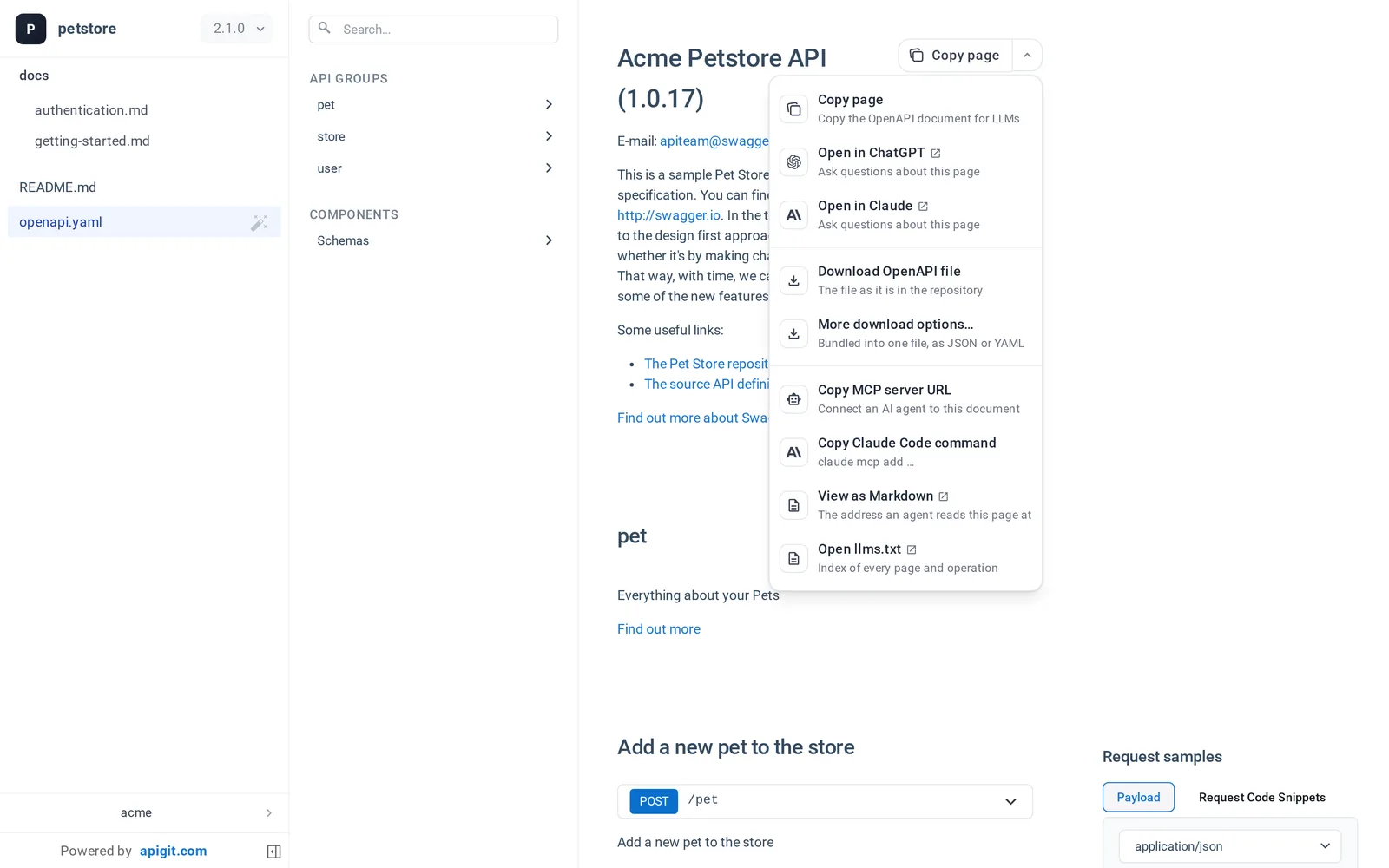
Every published version also answers in the formats coding agents read: llms.txt, a Markdown copy of each page, a bundled OpenAPI file, a Skill, and a read-only MCP server for Claude, Cursor, VS Code and other clients. An agent sees what the caller could open in the viewer.
AsyncAPI documents and GraphQL schemas each get one generated page per file. Separate operation and schema lookups are for OpenAPI. See what each agent page contains.
- Copy page on every page: copy it, or open it in ChatGPT or Claude
- The MCP address and a ready Claude Code command in the same menu
- A switch in Site Settings to turn agent access off
Preview on your machine, publish from the terminal
Working in a clone? apigit preview serves your working copy as the published page will draw it, with its navigation and theme, and reloads when you save. It uses the viewer of the published pages, not a copy of it. Logged in, it also reads the site settings saved for the repository.
- No login needed, and it works offline after the first run
--themetries any of the seven themes without saving oneapigit doc publishreleases a version from a script or from CI
$ npm install -g @apigit/cli$ apigit auth login$ apigit previewSite settings: from acme/petstore-platform$ apigit preview --theme clover$ apigit preview docs/intro.md$ apigit doc publish --version 2.3.0 --access publicPublish your first API document
Create a free workspace, add an OpenAPI file and a Markdown page, and publish them as one site from the commit you choose.
Free for individuals. No credit card.
$ npm install -g @apigit/cli$ apigit auth login$ apigit doc publish