How to find API governance?
Updated November 2026: The rule sets promised at the end of this post have shipped. See the API Governance documentation for the current feature.
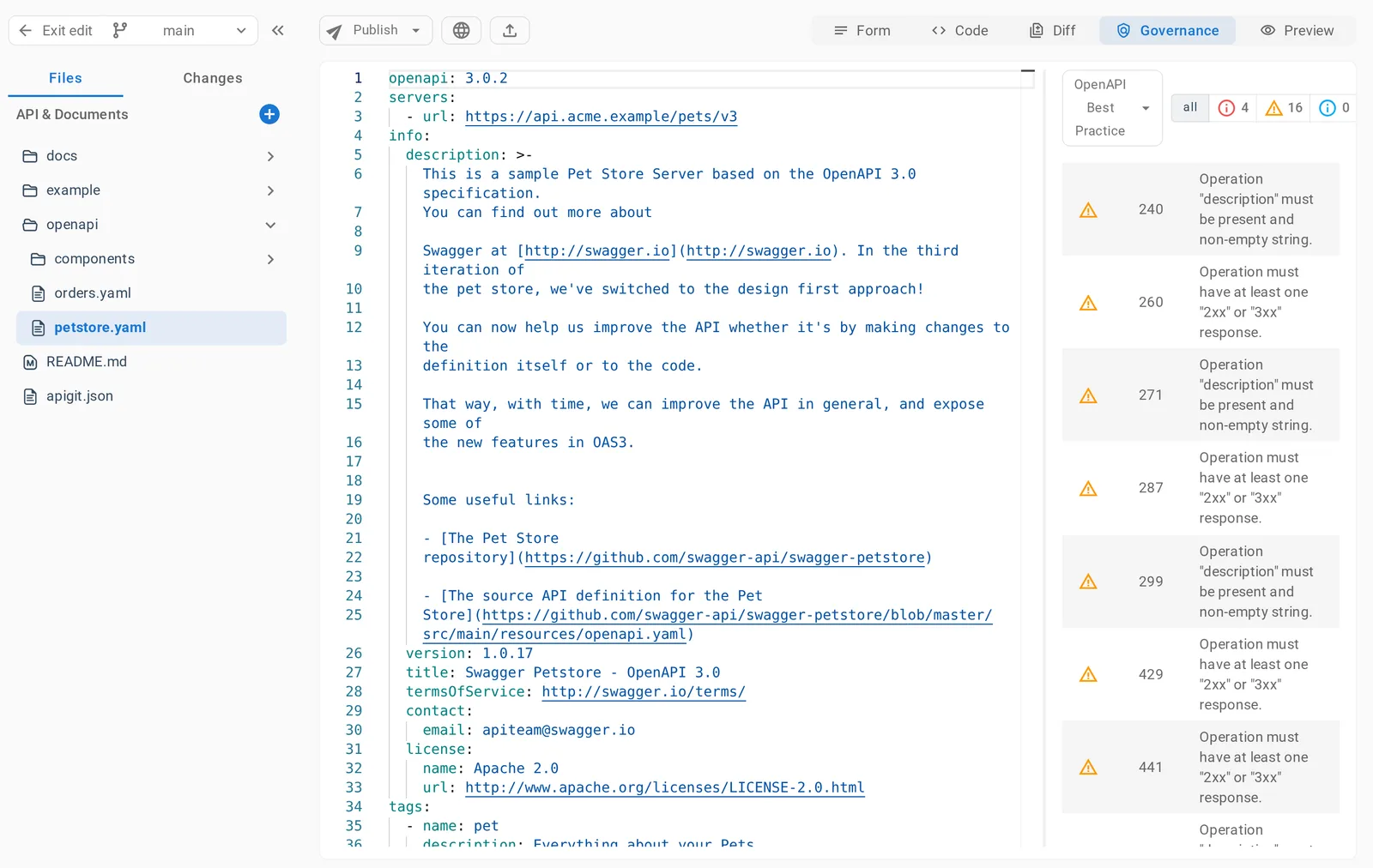
When you choose to edit your spec file, you will find several different views. One of them is called Governance. In this view, you will see the results of an audit, with each warning or error based on the rules you have set.
What will API governance help to do?
Here are the key points for API best practices:
-
Info: Make sure each API has essential properties like title, description, and other necessary information.
-
Versioning: Enforce the use of standard semantic or date-based versioning for each API.
-
Operations: Ensure that each individual operation includes a summary, description, and id.
-
Parameters: Standardize the format of parameter names and ensure that all parameters have appropriate descriptions.
-
Responses: Advocate for a common set of status codes, media types, and schema responses across APIs.
-
Schema: Standardize all request and response schemas using JSON Schema components.
What's next?
APIGit now offers two predefined rule sets, OpenAPI Best Practice and OWASP Top 10 Security, as well as custom rule sets.
API governance encompasses more than just design and standards; it revolves around empowering people and maximizing the value of APIs. By utilizing automation, workshops, and training sessions, API governance aids users in developing security measures, product definitions, and implementation strategies. To ensure its effectiveness, it is crucial to acknowledge all the components and implications of API governance. For further guidance, stay tuned to the Apigit blog for upcoming posts on essential API governance topics.
Related Posts
What Is the Purpose of API Governance?
API governance provides structure and oversight for API development, ensuring quality, security, compliance, and alignment with business goals. It helps organizations maintain consistency, reduce redundancy, maximize ROI, and improve the user experience through standardized documentation and design patterns.
Why Data Masking Matters for REST APIs
Data masking is essential for REST APIs to protect sensitive information, comply with regulations, maintain data integrity, enhance security, and facilitate testing environments, ultimately preserving user privacy and reducing breach risks.
Why Vulnerability Scanning Matters for REST APIs
Vulnerability scanning for REST APIs is crucial to identify security weaknesses, prevent data breaches, ensure compliance, maintain user trust, and protect your business reputation by addressing risks before they can be exploited.
Ready to get started with APIGit?
Create a free workspace, add an OpenAPI file and publish your first API document and mock server in minutes.